

Rwanda has done something many countries are still working towards: most adults are already part of the financial system, and paying with a phone is normal. Yet a typical day is still split between many tools that do not talk to each other. TumaChat exists to bring those moments into one simple, friendly place. This article explains the problem we see and the vision behind the app.
A typical day, in five different places
Think about an ordinary Tuesday in Kigali. You message your family in one app. You dial a USSD code and work through a menu to send money to your sister. You open a separate website for a public service. You visit a market where the vendor writes your debt in a notebook, and in the evening your ikimina meets and someone counts cash and updates another notebook.
Every one of those tools does its job. The problem is the gaps between them: copying numbers from a chat into a USSD menu, checking whether a payment arrived, searching for the right phone number, or remembering who already contributed to the group. Those gaps cost time and data, and they make mistakes easy.
The foundations are already strong
The good news is that Rwanda does not need to start from zero. Public research paints a clear picture:
- According to FinScope Rwanda 2024, around 96% of adults are financially included and about 86% use mobile money.
- The same survey found that roughly half of adults save through ibimina, the rotating savings groups many families rely on, mostly with cash and paper records.
- The national business census (NISR Integrated Business Enterprise Survey) shows that the large majority of Rwandan businesses are small and informal, often with no storefront, no sales history and no easy way to be found online.
So people already trust paying by phone and already save together. What is missing is a single front door that connects everyday conversation with everyday money.
Our vision: live connected, pay freely
TumaChat starts with the thing people do most on their phones, which is talking to each other, and puts money and services right next to it. A few principles guide every decision:
- Chat comes first. Conversation is the daily habit. Paying, saving and shopping should happen where the conversation already is, not in a separate app.
- Rwanda first, not translated later. Kinyarwanda, English, French and Kiswahili from day one, amounts in whole Rwandan francs, and features built for local habits such as ibimina and market payments.
- Work with what exists. Rwanda has excellent payment rails and public services. TumaChat is designed to be a friendly layer on top of them, not to replace them.
- One app instead of twelve. Mini Apps let services and shops live inside TumaChat, which saves storage and data on entry-level phones.
- Honest money. Every franc is recorded with double-entry accounting, and we say clearly what is live and what is not. Read how the wallet is built.

A conversation
Send money, fee: free

Ibimina: your circles
What this looks like in practice
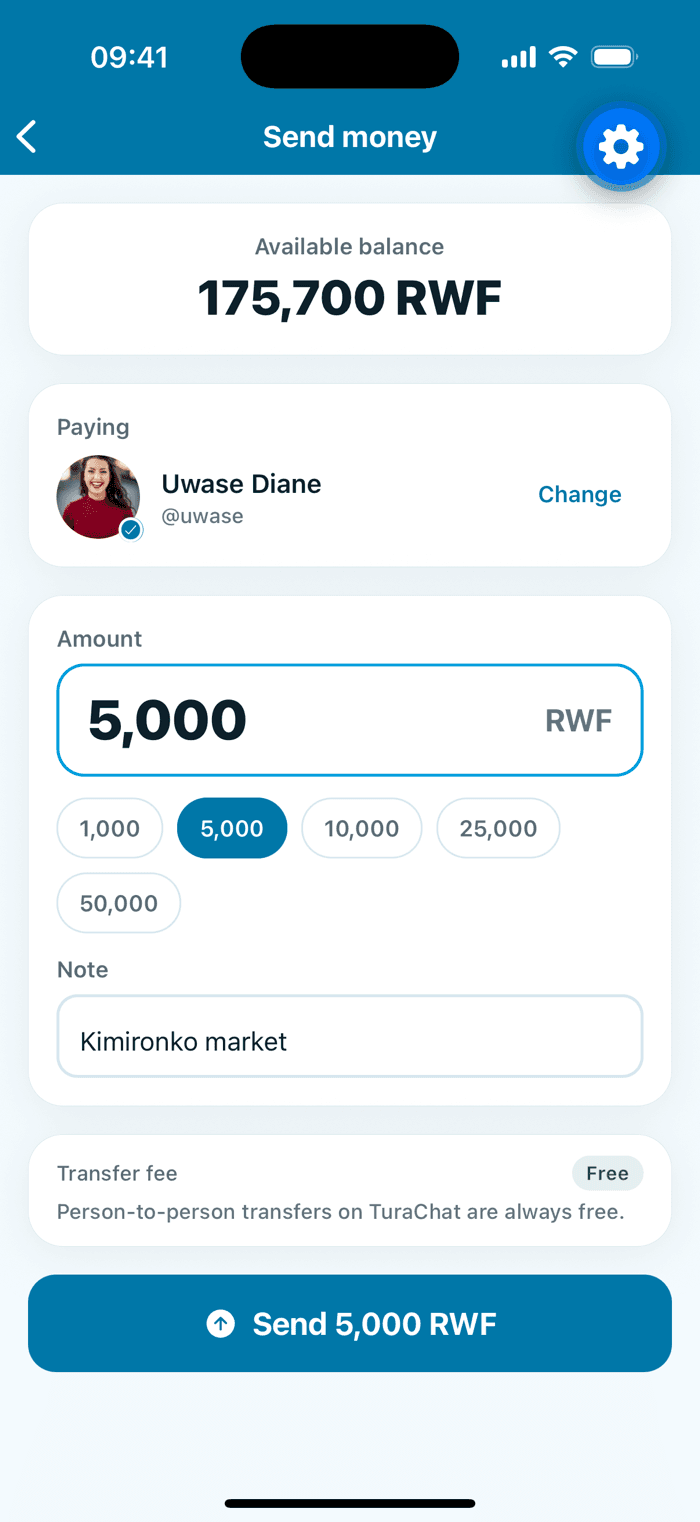
In the conversation above, a friend says she can take a QR payment at Kimironko market. In TumaChat, paying her is part of the same conversation: you send 5,000 RWF with a note, the transfer appears in the thread, and nobody has to dial a code or send a screenshot as proof. Sending money from one person to another is free.
The same idea runs through the whole app. Your savings group has its own chat and its own shared pot. A vendor shows a QR code in Market Mode and sees each payment arrive. A shop lists its products in RWF and is paid into the same wallet its owner already uses.
Built for everyone, not only the city
An everyday app for Rwanda has to work for a student in Kigali and a vendor who just bought her first smartphone. That is why TumaChat keeps screens simple, uses large QR codes for vendors, offers four languages that switch instantly, and uses Mini Apps so services do not each need their own download. The TumaChat AI assistant can also explain any part of the app in your own language.

